
Coca-Cola has launched its “Enjoy Joy” holiday campaign across television, digital and social content, experiential activations, packaging and partnerships. The spots portray families and friends taking part in seasonal activities and run in 30-, 15- and six-second versions across linear TV, digital, streaming and social platforms. WPP Open X and Ogilvy led the work, which clearly moves away from the generative-AI direction used in the brand’s holiday advertising over the previous two years.\n\nThis is not an announcement that AI has been eliminated, nor does it mean every market or brand will return to one production model. What is known is that Coca-Cola has chosen human connection as the creative center while placing creator content, social programming, media partnerships, out-of-home activity and limited-edition packaging within one seasonal framework. Millennium Global Marketing’s view is that Taiwanese enterprises should examine how creative judgment can return to situations consumers can feel, understand and willingly share when efficiency tools create audience division.
The “Enjoy Joy” campaign is not just one film. It combines seasonal touchpoints: television and streaming establish the setting, social and creator content extend the conversation, while experiential activity and packaging bring the holiday cues into physical and purchase contexts. The article also describes a social series centered on older family members and holiday traditions, allowing togetherness to live beyond the advertising frame.
The immediate implication for businesses is that creative work cannot be judged only by production speed. When one idea must travel across short video, longer film, events, packaging and partnerships, audiences judge whether it feels credible and relevant at every contact point. Coca-Cola is still using digital, social and creator media; it has moved the creative center from the form of generated imagery back to recognizable human activity.
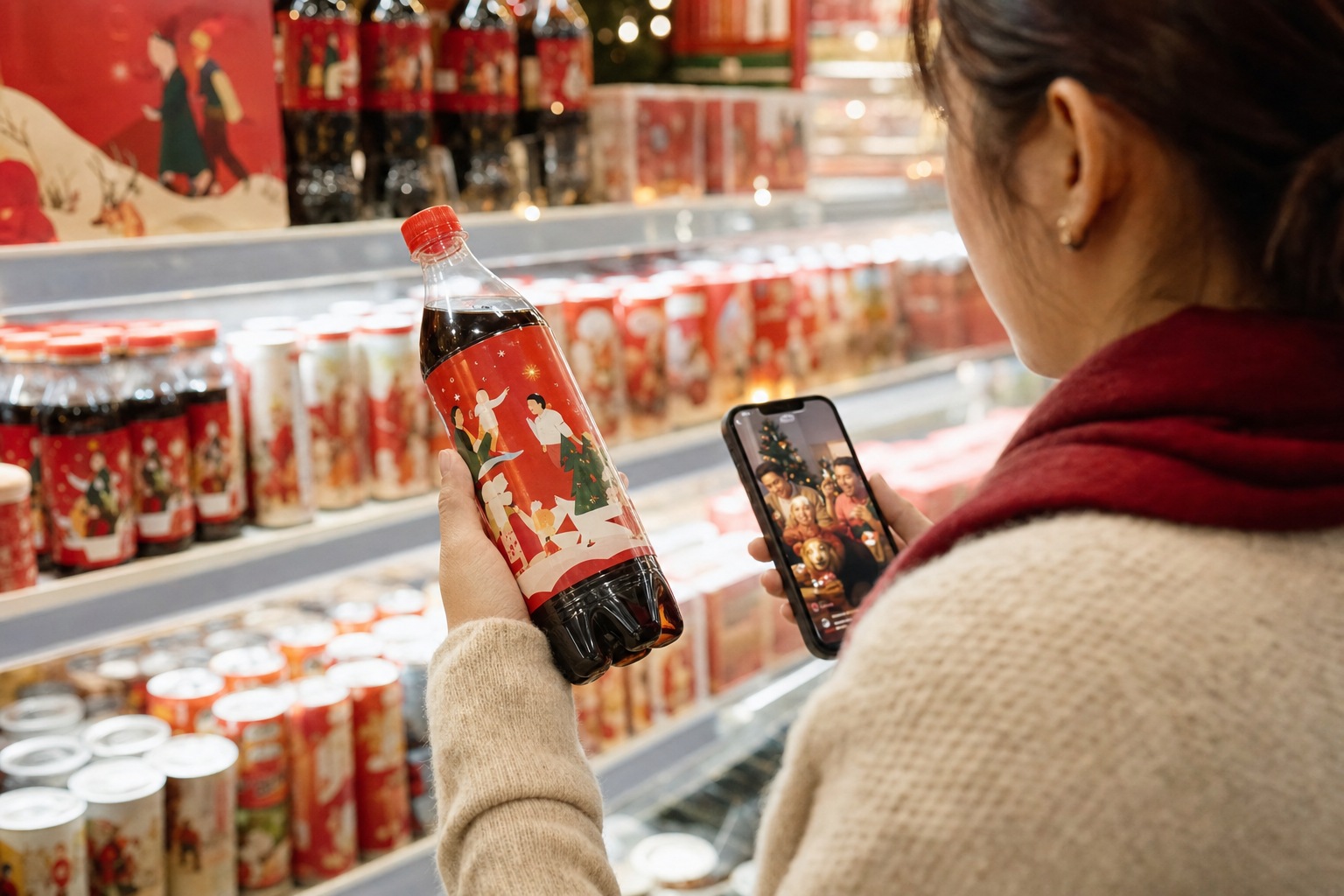
Millennium editorial analysis reaches a specific judgment: Taiwanese companies should not reduce this shift to “human-made is better than AI.” A more useful conclusion is that when a brand promise rests on companionship, tradition or togetherness, audiences become more sensitive to facial expression, physical detail and cultural context. Production methods must therefore serve credibility. Generative tools may help with ideation, versioning or early alignment, but they cannot automatically give a brand emotional legitimacy.
This judgment also avoids the opposite extreme: assuming that filming real people removes controversy. If a story merely piles up seasonal symbols, or if each platform rewrites the brand voice independently, human footage can still feel calculated. Hypothetically, a Taiwanese food brand promoting a Lunar New Year gift set should not simply compare an AI version with a live-action version by views. It should test whether people can explain the relationship in the story, the product’s role and why they would share it, while tracking whether negative feedback clusters around unnatural or irrelevant moments.
Millennium's view:Millennium editorial judgment: Coca-Cola’s pivot should not be read as an abandonment of generative AI. It is a reminder to evaluate efficiency separately from emotional credibility. For brands built around togetherness, tradition or companionship, human situations and cross-channel consistency should be checked before the production method itself. The reported facts confirm that “Enjoy Joy” centers on seasonal interactions among family and friends and extends into social, creator, experiential and packaging activity; they do not prove that human-made production automatically delivers better results. Taiwanese businesses should therefore treat AI as an optional tool, while validating audience understanding, cultural fit and subsequent behavior as the outcomes that matter.

For Taiwanese businesses, the first step is not to ban generative AI across the board, but to map where a brand promise needs evidence from real human situations. For food, retail, travel or local brands, a company could select one holiday theme, specify what the film, creator post, store display and package should each help people understand, and then check whether voice, relationships and the product’s role remain consistent. This turns the question of whether something “feels real” into a discussable content standard.
The second step is a small-scale comparison of creative versions and a structured classification of feedback, rather than treating one click-through rate as the creative verdict. Responses can be grouped as understanding, resonance, confusion or rejection, while the business records whether people move from viewing to inquiry, store visits or adding an item to a basket. Hypothetically, if a video earns views but most comments cannot explain the product’s role, the company should revise the narrative and product information before increasing media spend.
Suggested action 1:Create a holiday-content consistency checklist covering relationships, product role, cultural context and the core message that must remain stable across channels before producing or generating assets. Review one film, creator post, store execution and package with at least five target consumers; record the consistency rate of the stated brand promise and the most common misunderstanding.
Suggested action 2:Create a small-scale live-action version and a tool-assisted version around the same holiday theme, testing understanding, resonance, confusion and rejection with a limited audience instead of declaring a winner from views alone. Under comparable media conditions, collect qualitative feedback and completion rates for each version, then compare the share of viewers who correctly identify the product’s role and brand promise.
Suggested action 3:Design a holiday path test from content to action, tracking social viewing, product inquiry, store or experience visits and shopping behavior as connected steps. Review the next-step rate and drop-off point at each touchpoint weekly, classify comments showing confusion about the story or product, and address each issue in the next creative iteration.

Source:Marketing Dive — Coca-Cola pivots from divisive AI-generated ads for holiday campaign(2026-11-19,Taipei time)。Analysis: Millennium Strategy editorial team. Images are AI-created illustrative scenes.
Related reading and services:Influencer and KOL marketing · Creator collaboration and measurement。