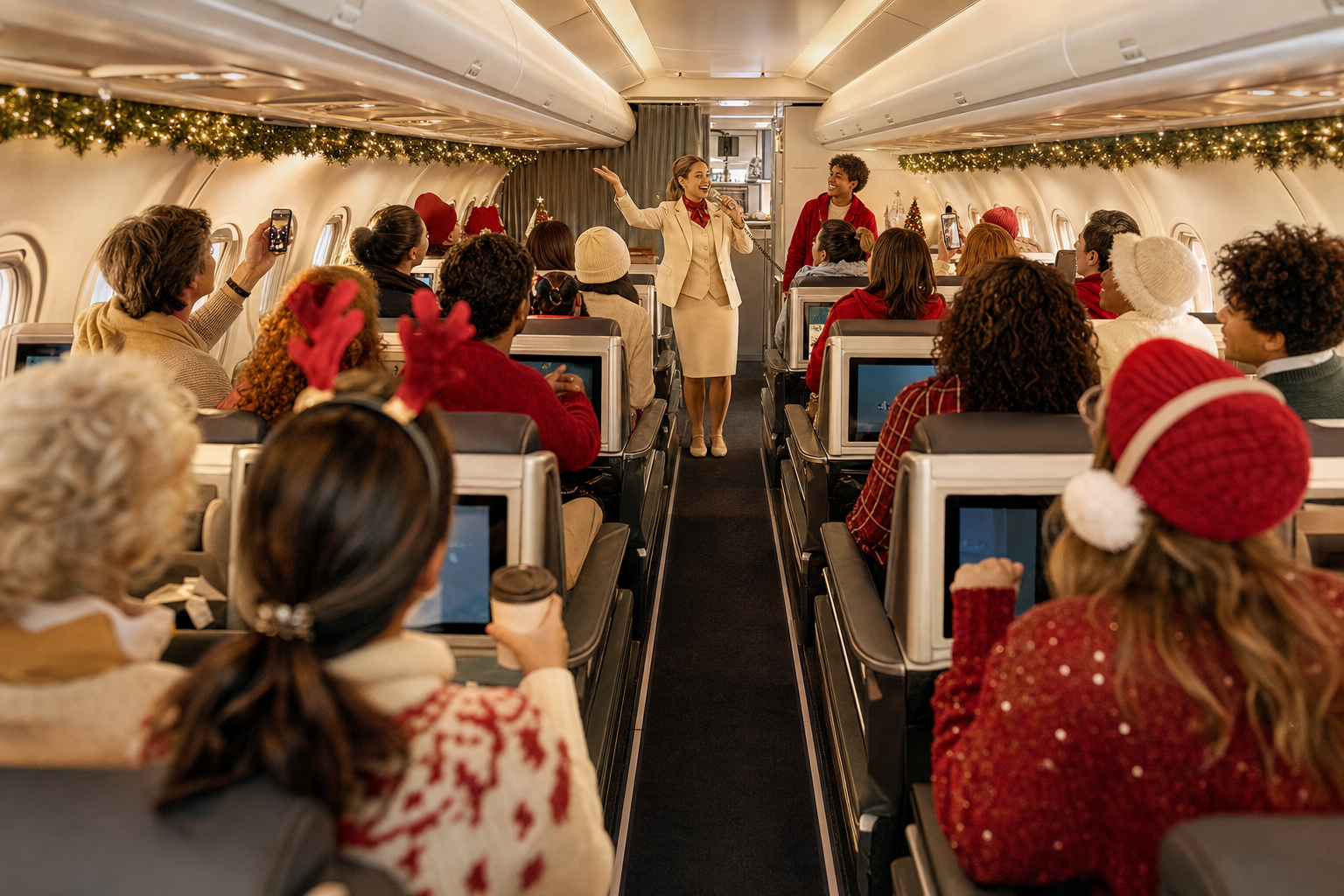
Marketing Dive reports that Old Navy launched a holiday campaign built around its celebrity “Jingle Jet,” while Gap continued its music-led approach with three choirs. Rather than chasing the same kind of attention, the sister brands are maintaining distinct memory structures.
In the reported Old Navy campaign, Alan Cumming and Meg Stalter appear as the crew of the “Jingle Jet,” joined by passengers including Paris Hilton and Charli D’Amelio. The spot shows sequined dresses, family pajamas and performance fleece before closing with a value-oriented message. Gap, meanwhile, uses three choirs singing the Jackson 5’s “I’ll Be There,” continuing its recent music-led holiday storytelling around individuality, creativity and community.
Consumers are therefore given two different entry points, not simply two holiday product ads. Old Navy uses a flight, celebrities and spectacle to earn attention, then places price and family dressing inside the narrative. Gap starts with music and collective performance, then extends the idea across digital, social, owned channels and an in-person experience. For Taiwanese businesses, the important question is how a format answers, in advance, “Why should people remember this brand?”
The report also notes that an earlier Old Navy celebrity collaboration generated engagement but not traffic, as the company adjusted its marketing direction. That distinction matters: a celebrity or creator may increase conversation without automatically producing store visits, clicks or purchases. Seasonal reach should not conceal that gap.

Millennium’s editorial judgment is that the transferable lesson is not hiring celebrities, filming on an airplane or copying a choir. It is preserving a recognizable creative entry point for each brand during a crowded seasonal moment. Gap is developing a holiday music thread through different songs, while Old Navy connects celebrity ensemble storytelling with affordability, family dressing and fun. The form can change without rebuilding the brand’s first association every year.
This is particularly relevant to Taiwanese companies with multiple brands, audiences or price tiers. If every sub-brand uses the same celebrities, short-video tone and discount language, media exposure may rise while brand distinction weakens. A better sequence is to define each brand’s holiday role first—for example, “help the family finish festive outfits quickly” or “turn gifting into a shared memory”—and only then choose talent, music, scenes and channels.
The following is a hypothetical analytical example, not a reported case: a Taiwanese lifestyle company with an entry line and a design line could use a family scene about completing holiday preparations to communicate value and convenience for the entry line, while the design line uses creator-made music or craft content to express taste. Both can share the season, but they should not share the same memory hook.
Millennium's view:Millennium editorial judgment: Taiwanese businesses should borrow the division of brand memory entrances, not the celebrity or music formats themselves. Old Navy and Gap operate within the same group and seasonal competitive environment, yet maintain different narrative directions: a flight ensemble versus choral music. This suggests that seasonal creative efficiency comes not only from reach, but from how quickly audiences can distinguish a brand’s role. The report also notes that engagement does not necessarily produce traffic, so businesses should measure memory, product reason and next action separately. This is Millennium Global Marketing’s independent editorial analysis, not the news publisher’s position.

To apply this case, businesses should not ask only about video views or social comments. First, create a one-page holiday message map for each brand: its single promise, intended emotion, product proof, next customer step and language that must not be shared with another brand. This checks whether the creative roles are genuinely distinct before production is complete.
Next, break celebrities, music and settings into testable units. As a hypothetical approach, the same product page or store entry could use either an “ensemble spectacle” asset or a “shared performance” asset, then observe whether different audiences move more readily to product views, saves, cart additions or store appointments. The goal is not to prove that one format always wins, but to learn which entry point helps a particular brand’s message get understood.
Finally, leave room to interpret weak results. If engagement rises but product-page attention, store redemptions or purchase intent do not move with it, the issue may lie in product information, the landing page, inventory visibility or the next-step design—not necessarily in the creative idea. Taiwanese businesses should treat seasonal activity as an inspectable path connecting memory, product reason and action interface before deciding whether to scale.
Suggested action 1:Create a holiday message map for each brand defining its promise, emotion, product proof and single action, while marking language that must not be shared. Before launch, run a blind message-card test with brand owners; at least 80% of participants should correctly match each brand with its promise, with a documented list of duplicated phrases.
Suggested action 2:Connect two distinct creative entry points to the same product or store journey in a small asset test instead of treating views as the only success condition. Record post-view product-view, save, add-to-cart or store-appointment rates for each asset and compare the difference at every step.
Suggested action 3:Build a content-product-action checklist for the holiday campaign and, when engagement rises without downstream improvement, inspect the landing page, product information, inventory cues and next-step design first. Review engagement, product-page attention, completed actions and store redemptions weekly for the same periods and channels, documenting issues, changes and subsequent movement.

Source:Marketing Dive — Old Navy flies with celebs, Gap keeps it acapella for holiday campaigns(2026-11-05,Taipei time)。Analysis: Millennium Strategy editorial team. Images are AI-created illustrative scenes.
Related reading and services:Advertising management · Advertising strategy and measurement。