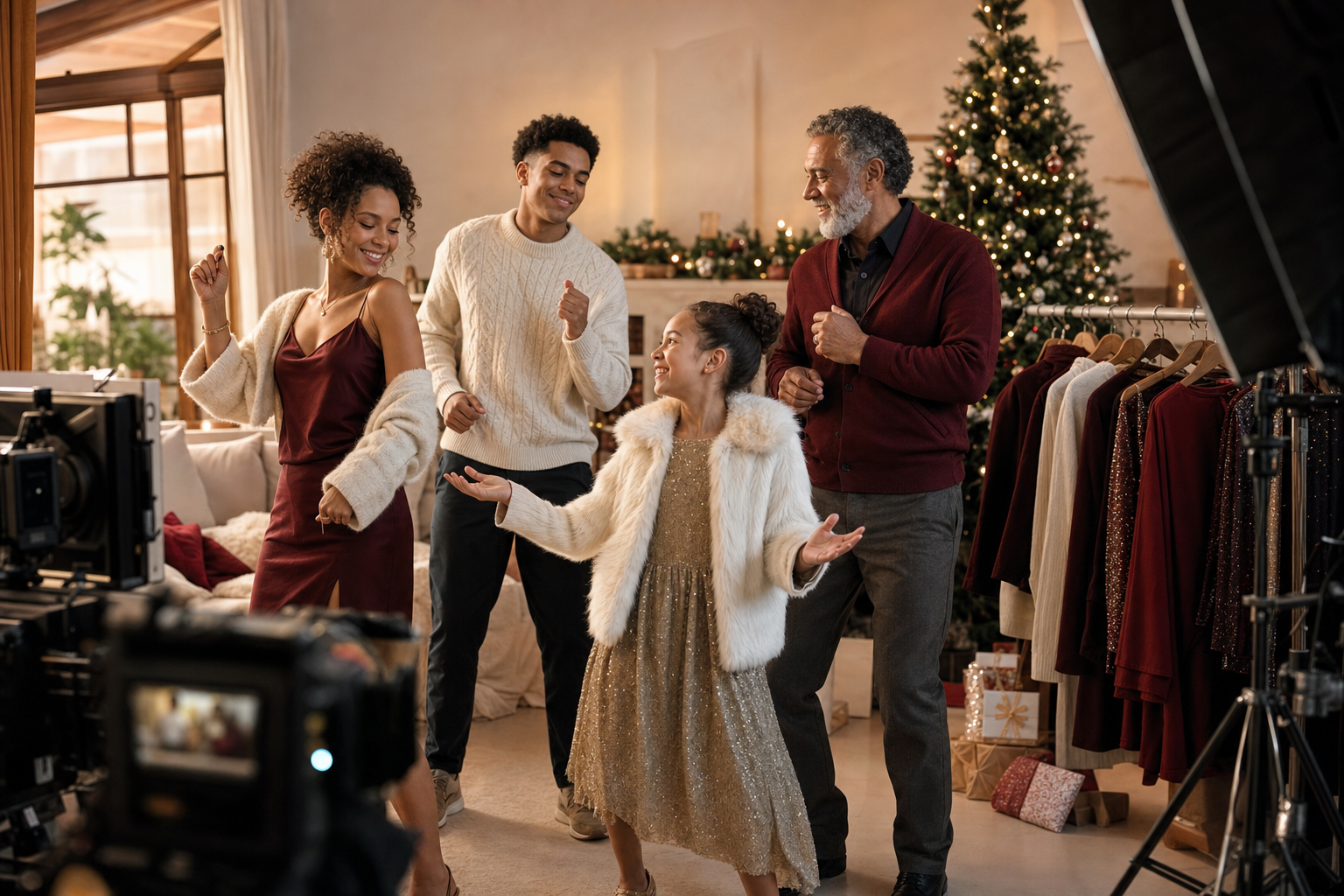
Express has announced “Holiday, Hamlin Style,” featuring Lisa Rinna, Harry Hamlin, Delilah Belle Hamlin and Mick Maio in a holiday campaign that brings family dynamics, pop culture and seasonal situations to video, social, digital and in-store channels. This does not mean the same campaign or results are available in Taiwan; it is a useful case to examine. As seasonal competition intensifies, a celebrity cast must create both recognition and shareable social behavior.
According to Marketing Dive, Express’s new campaign builds on organic social engagement from its spring work and uses the family dynamic of Rinna, Harry Hamlin, Delilah Belle Hamlin and Mick Maio as a cross-generational entry point. It runs across video, social, digital and in-store channels, combining holiday situations, remixed Nutcracker music and fashion presentation. The report also says an earlier fall campaign produced the brand’s highest earned-media and paid-media website traffic of the year so far, while awareness and consideration rose 3% and 2% from Q2 to Q3. These are Express’s reported claims, not universal proof that celebrity partnerships caused the results.
The meaningful change is not simply a new group of endorsers. It is the use of family relationships as a content engine. A mother, father, daughter and daughter’s partner create different roles within one narrative, giving several age groups a reason to watch; dances, punchlines and seasonal vignettes can also be cut into social units. Taiwanese businesses should first ask whether talent can naturally perform the intended brand situation, then examine audience size—not assume that more celebrities automatically create multigenerational relevance.

Millennium editorial analysis sees the most transferable lesson in Express’s case as follows: design interactive content units first, then use media to amplify them, rather than publish one finished image film everywhere. The report links Express’s brand platform with its Expressionists community of creators, associates and ambassadors, suggesting that social-first work requires people to perform the brand idea in multiple versions. It does not, however, prove that every content unit drove sales or provide a replicable result for Taiwan.
Hypothetically, a Taiwanese fashion or lifestyle brand could create three short scenes in which different roles respond to one another: an older family member choosing a gift, a younger person restyling an outfit, and a couple disagreeing about a holiday occasion. It could then use a small test to see whether comments discuss the intended consumer situation rather than merely praising the celebrities. If interaction centers on gossip or dancing, the script, product role and follow-up information need adjustment; if completion is strong but product-page visits are weak, the handoff—not the lack of another celebrity—may be the issue.
Millennium's view:Millennium editorial judgment: the value of a celebrity family is not one-time reach, but its ability to turn a brand promise into multiple interactive, measurable life situations. Taiwanese businesses should test content and the customer path before deciding the scale of a partnership. Express combines distinct family roles, seasonal situations and social-first distribution, creating a plausible route across audiences. Yet the reported changes in awareness, consideration and media traffic belong to that brand and cannot be transferred directly to Taiwan. Without separating comment quality, brand understanding, product-information interaction and subsequent action, a business can mistake celebrity heat for brand growth.

Taiwanese businesses should evaluate this kind of campaign on three levels: whether the talent earns attention, whether the content makes the brand meaning understandable, and whether that understanding leads people to explore products or stores. Express says the campaign will run across multiple channels and aims to reengage existing customers while reaching a new generation of shoppers. The more channels involved, however, the more important consistent message markers and handoffs become. Otherwise a business may know where traffic came from without knowing which family situation improved consideration. Taiwan market fit, product prices and distribution conditions require separate validation.
A practical first step is to test two or three versions of the same product situation before scaling: one emphasizing interpersonal performance, one emphasizing seasonal use, and one letting a creator demonstrate the reason for a choice. Observable measures can include three-second views, completion rate, need-related language in comments, product-information clicks and store-redemption or add-to-cart intent. These measures describe path performance; they do not promise revenue. This makes celebrity participation a testable content hypothesis rather than a one-off exposure cost. If attention and brand understanding diverge, the business has grounds to reduce the celebrity scope and invest in creators closer to the usage situation.
Suggested action 1:Create two or three narrative versions of the same product situation and run a small social test, separating interpersonal performance, seasonal use and creator demonstration. Compare three-second view rate, completion rate, the share of need-related language in comments and brand associations to see whether attention and understanding move together.
Suggested action 2:Build a consistent handoff across video, social posts, product pages and in-store displays so customers can move from the holiday story to product use, specifications or fitting choices. Track product-information clicks, page dwell time, add-to-cart behavior or store-redemption intent by channel, comparing them with audiences who only viewed the content.
Suggested action 3:Set stop-or-scale criteria before expanding a celebrity partnership, using one defined audience and one seasonal need for a short customer-path experiment. During a defined observation period, record differences from content exposure to brand search, product interaction and store or purchase intent, without presenting the results as a revenue guarantee.
Source:Marketing Dive — Express unwraps holiday campaign to build on brand metric gains(2026-11-02,Taipei time)。Analysis: Millennium Strategy editorial team. Images are AI-created illustrative scenes.
Related reading and services:Advertising management · Advertising strategy and measurement。